
Transfer of Care

![Apple Podcasts md:mr-[10%]](/apple.png)


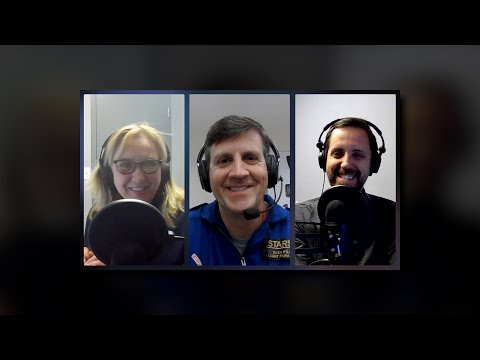
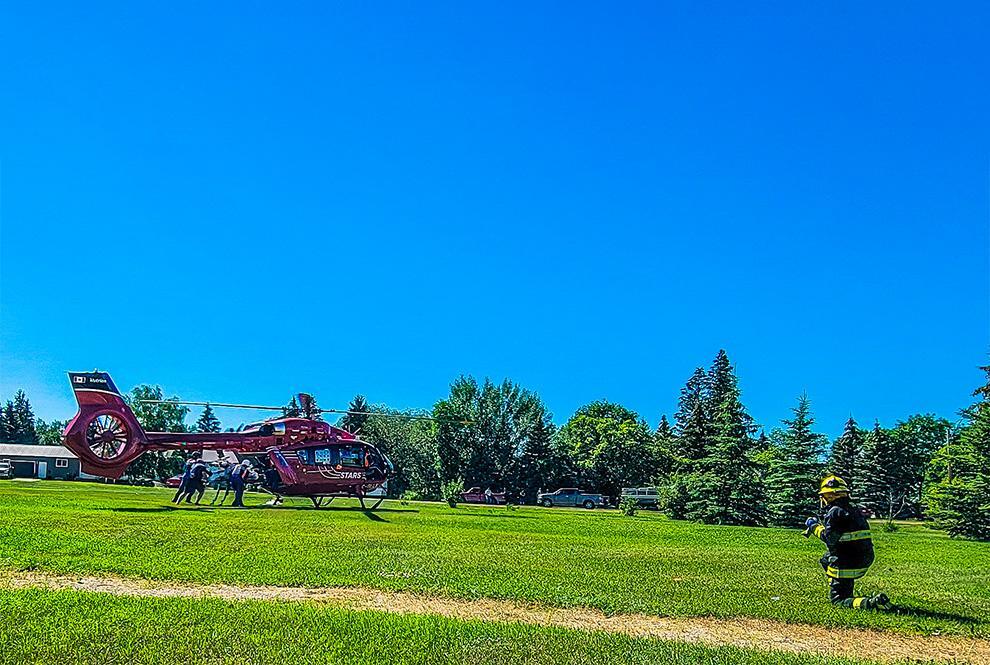
The industrial riding lawnmower that had been sitting on top of Draidyn Wollmann is finally removed and he’s whisked off to the STARS helicopter running nearby. His mom, who is also a first responder, has shown poise and strength and is allowed to join the flight to the city trauma centre. While en route, the STARS air medical crew continues to perform critical care on Draidyn, and hospital staff stands ready to take over. Watch the STARS flight paramedic talk about his glimmer of hope in a bonus video below.
When you lift the lawnmower deck off of him and you see a hole in his chest the size of a football… I didn’t think when we put him on the helicopter he’d be coming off alive. I was very amazed he was still alive, actually.”
- Chris Dennis, Laird Fire Chief
Episode 4 Bonus Content
-
Season 2, Episode 4 Transcript
00:00:01:28 – 00:00:33:27
Co-host Deborah Tetley: Before we start, a word of caution. As you know, STARS provides pre-hospital care for critically ill and injured patients who have sustained severe trauma or debilitating illnesses. It’s what we do. As such, some of the details in this podcast may be difficult for some listeners. The STARS mission being explored this season involves graphic descriptions of physical injuries to a youth. Psychological impacts are also detailed. The patients, family, and supporters have generously allowed us to tell this story as a personalized insight into STARS.00:00:33:29 – 00:01:10:16
Co-host Lyle Aspinall: And for that, we are genuinely grateful. The community, and everyone else who was involved, welcomed us with open arms to help us tell this story. Having spent time with about 20 people researching it and recording interviews on the phone, virtually, in studio, and right at the scene of the incident, we can tell you this: our conversations were raw and candid, and as such, some of the details uncomfortable. For this podcast, we’ve endeavoured to tell the story accurately without being too sensational. Still, listener discretion is advised.00:01:10:19 – 00:01:18:07
Flight paramedic Glen Pilon: And so the fire department then went to dismantle this entire lawnmower, and they had it dismantled in two minutes.00:01:18:10 – 00:01:28:14
Flight nurse Bailey Sinclair: I honestly wasn’t sure at that time if he was going to make it when the lawnmower came off of him. He was just fighting for his life at that time, and it was something I was really unsure of.00:01:28:16 – 00:01:37:15
Chris Dennis: I didn’t think when we put him on the helicopter he’d be coming off alive. I was very amazed he was still alive, actually,00:01:37:17 – 00:01:47:15
Kevin Burrell: Just by looking at someone, you can you can kind of tell if they’re going to make it or not. From looking at him, I didn’t think he was going to make it.00:01:47:17 – 00:02:02:21
Co-host Deborah Tetley: Welcome to Mission Ready, presented by ARC Resources. This STARS podcast breaks down in detail one mission each season to give you a stronger understanding of how we provide critical care anywhere, and what happens before and after the mission. I’m Deborah Tetley.00:02:02:23 – 00:02:18:05
Co-host Lyle Aspinall: And I’m Lyle Aspinall. In Season 2, we analyzing an emergency response to a traumatic incident where a teenager was run over by an industrial-sized riding lawnmower in Laird, Saskatchewan. This is Episode 4: Transfer of Care.00:02:18:07 – 00:02:44:00
Co-host Lyle Aspinall: By now, you’ve gained a solid understanding of the massive team working together to give Draidyn Wollmann a fighting chance after being run over by an industrial lawnmower. At the scene, several things are happening at once. With the mower still on top of Draidyn and firefighters trying to figure out how to best get it off of him, STARS flight nurse Bailey Sinclair begins infusing blood through the large bore IV line the ground paramedics have already put in place, and STARS flight paramedic Glen Pilon preps for an intubation.00:02:44:02 – 00:03:23:23
Flight paramedic Glen Pilon: Yeah, he is on ground level. He’s on his back, he’s looking up to the sky, and he has his right arm sticking out from underneath the lawnmower, right beside the wheel. And just from his neck up is all that we can see, really. And so we set up right at the head and we get all of our equipment out. We get all of our intubation equipment out, we get our bag valve mask, we get our oxygen out, we go back to the helicopter and we get the blood box. The pilot, the safety pilot, is there to bring that to us. Open up the blood and start infusing the blood as we’re setting up for other things.00:03:23:25 – 00:03:52:29
Flight nurse Bailey Sinclair: He was kind of in and out of consciousness, just gasping for air. He had an IV in the one arm that was out from the lawnmower. So immediately I started giving him blood while he was still under the lawnmower, while Glen set up to capture his airway. While I was doing that, Glen was getting ready for this airway, and I was kind of thinking, What is going to happen once we lift this lawnmower off of him? So a lot of things cross my mind.00:03:53:01 – 00:06:15:02
Flight paramedic Glen Pilon: We make one attempt to try and intubate him as the blood is going into him. We get better hemodynamics and so we can go ahead and make our intubation attempt. And we use a video laryngoscope to do that. And the video laryngoscope has a cord on the very top of the handle. So if you can imagine kind of a hockey stick that’s cut off just above the blade; you have a blade that goes into the mouth and then a handle that comes up. And on top of that handle is a cord that goes to the video screen. And because it’s a very bright day outside, you have a glare on that video screen. So you can do your direct laryngoscope, you can go in and see the mouth, but because he’s laying on the ground, you have to also get down as low as you can to see into the mouth, because you want to put that tube into the trachea and not into the esophagus, because you want to assist his breathing. So when I go to put the blade in, the top of the laryngoscope handle, where the cord is, it hits the lawnmower and it is stuck there, and I’m not able to lift up in order to see the epiglottis that I need to see where the vocal cords are in order to pass the tube in. So we had to make the decision to try and do a type of a blind insertion using a bougie, which is kind of a plastic stick that will go into the vocal cords. And what you feel for is the tracheal rings along the front of your throat here, and that fine feeling of a little bump, bump, bump as you’re pushing this plastic rod down. And then you would put the endotracheal tube over top of that and into the patient’s airway so that you can assist the breathing. But I was not able to see the vocal cords or feel any tracheal rings. So we had to come back out and we had to manually just ventilate the patient using just an oropharyngeal airway, which is about this far, that just goes just behind the tongue. And we had to make the decision to take off the lawnmower base in order to get that airway in to him, to assist his breathing. All the while, there’s still a blade inside his chest.00:06:15:04 – 00:06:54:29
Flight nurse Bailey Sinclair: The first responders had said that they believed the blade was in Draidyn’s chest, and they were worried that when they lifted it off that he might bleed out from that side. So I was thinking things about, okay, we might need to apply some pressure. We might need to give more blood. What might we need to do to stop this bleeding when we lift the lawnmower off? I was also worried that if the blade was near his chest or in his lungs that we might have to decompress his chest. So it’s kind of our version of doing a chest tube out on the scene, just to help that lung re-expand if it had collapsed while the lawnmower was on him. So I was thinking lots of other things while getting medications and blood ready for this intubation.00:06:55:01 – 00:07:02:11
Co-host Lyle Aspinall: One volunteer firefighter on scene had firsthand knowledge on how to take the lawnmower apart. Laird fire chief Chris Dennis talked to us about it.00:07:02:13 – 00:07:43:07
Chris Dennis: These lawnmowers are not just like normal lawnmowers. They’re big industrial lawnmowers, and they’re built and maintained and and all that right in our town. And one of the lucky things we had that day was, the head mechanic in that lawnmower shop is on our fire department. He was one of the first firefighters on the scene, and he was there instructing us and helping us to take it apart because it was like, if you’re going to do this type of stuff, you’re going to cause more problems and more injury. He was an integral tool to us getting the lawnmower off of him in such quick time without causing more damage to him.00:07:43:10 – 00:07:50:23
Flight paramedic Glen Pilon: And so the fire department then went to dismantle this entire lawnmower, and they had it dismantled in two minutes.00:07:50:25 – 00:08:13:05
Flight nurse Bailey Sinclair: I honestly wasn’t sure at that time if he was going to make it when the lawnmower came off of him. He was just fighting for his life at that time, and it was something I was really unsure of. So once Glen was all ready for the intubation or to capture his airway, and I had all the blood and medications ready, we got the first responder crew to lift the lawnmower off of Draidyn.00:08:13:08 – 00:08:29:25
Co-host Lyle Aspinall: It was everyone’s first view of the damage the mower had done. One of Draidyn’s feet was injured from being dragged under a wheel, but worse, there was a large hole in his chest and his left arm was mostly severed. First responder Kayla Burrell was holding the bag of blood that was going into Draidyn’s other arm.00:08:29:28 – 00:09:03:04
Kayla Burrell: At that point, they had given him medication that put him under, I guess. So, like, he was, he wasn’t speaking anymore. But we got him out and could see the extent of the injuries. And um… I’d never seen anything like it. And I honestly don’t want to see anything like it ever again. And I did, I was holding the blood bag and one of my fellow firefighters asked, Do you want me to take over? Can I hold it? And I was like, no, I’m good. Like, this is– I wanted to do more, like, this is all I can do right now is hold this blood.00:09:03:07 – 00:09:18:06
Chris Dennis: When you lift the lawnmower deck off of him and you see a hole in his chest the size of a football… I didn’t think when we put him on the helicopter he’d be coming off alive. I was very amazed he was still alive, actually.00:09:18:08 – 00:09:34:26
Flight nurse Bailey Sinclair: When they lifted the lawnmower off of him, we could see that his left arm was severely, severely injured. It was gaping open, hardly attached. And then he also had a large injury to kind of to his abdomen.00:09:34:29 – 00:09:51:14
Flight paramedic Glen Pilon: And he had this high visibility vest that was on him. It was all twisted around and in a ball on his chest and completely covered in blood. And we were successful in Intubating him at that time.00:09:51:17 – 00:10:01:15
Flight nurse Bailey Sinclair: So Glen got the airway. Everything went really well, and we actually were able to get Draidyn out from under the lawnmower onto a stretcher.00:10:01:17 – 00:10:17:23
Flight paramedic Glen Pilon: And we were able to get the second unit of blood started into him as we moved him towards the helicopter.00:10:17:25 – 00:10:27:12
Co-host Lyle Aspinall: Their off-duty manager, Daniel Kobylak, who was standing nearby, got on the phone to update STARS transport physician, Dr. Segun Oyedokun, who you heard from in the previous two episodes.00:10:27:14 – 00:10:46:01
Daniel Kobylak: It was a very busy scene, as you can imagine, and Bailey and Glen were doing an amazing job taking care of Draidyn. And I just looked at everything that was going on and I thought, you know, now’s a good time for me to step back and update our transport physician and make sure that the receiving centre knows as well too what’s about to come in.00:10:46:03 – 00:10:47:18
STARS EMERGENCY LINK CENTRE — Sharlene: …Sharlene speaking.00:10:47:21 – 00:10:50:28
STARS EMERGENCY LINK CENTRE — Daniel Kobylak: Sharlene, Daniel here, just backing up STAR 11. I need Dr. O, please.00:10:51:04 – 00:10:52:08
STARS EMERGENCY LINK CENTRE — Sharlene: You got it. One moment.00:10:52:10 – 00:10:55:17
STARS EMERGENCY LINK CENTRE — Daniel Kobylak: Thanks.00:10:55:19 – 00:10:56:00
STARS EMERGENCY LINK CENTRE — Segun: Hello.00:10:56:04 – 00:10:58:25
STARS EMERGENCY LINK CENTRE — Sharlene: Hey, Dr. Oyedokun, AMC on the line, one moment.00:10:58:27 – 00:11:12:08
STARS EMERGENCY LINK CENTRE — Daniel Kobylak: So, Dr. O, we just got the mower deck off of him. I’m just here helping Glen and Bailey. He is quite, quite down. We still do have a faint pulse, significant trauma to the chest. And the whole thoracic cavity is open from the mower blade.00:11:12:11 – 00:11:17:27
STARS EMERGENCY LINK CENTRE — Segun: Has it gone through the thoracic cavity? Did it perforate the lungs? Do you know?00:11:18:00 – 00:11:25:10
STARS EMERGENCY LINK CENTRE — Daniel Kobylak: Hard to tell. There’s quite a bit of trauma there right now. We’re just working on getting the (inaudible) airway in place. And we’ll be transporting here soon. I just wanted to give you an update. Thanks.00:11:25:10 – 00:11:26:22
STARS EMERGENCY LINK CENTRE — Segun: Absolutely.00:11:26:23 – 00:11:27:17
STARS EMERGENCY LINK CENTRE — Daniel Kobylak: Thanks. Bye.00:11:27:19 – 00:11:28:07
STARS EMERGENCY LINK CENTRE — Segun: Okay. Bye.00:11:28:14 – 00:11:30:04
STARS EMERGENCY LINK CENTRE — Sharlene: Thanks, Dr. Oyedokun.00:11:30:07 – 00:11:36:16
STARS EMERGENCY LINK CENTRE — Segun: Sharlene, do you want to put me through to the peds emerg doc, please?00:11:36:17 – 00:11:37:02
STARS EMERGENCY LINK CENTRE — Sharlene: You got it.00:11:37:02 – 00:11:38:17
STARS EMERGENCY LINK CENTRE — Segun: So I can give them this update, yeah,00:11:38:18 – 00:11:43:07
STARS EMERGENCY LINK CENTRE — Segun: Yeah, give me one moment.00:11:43:10 – 00:11:50:25
Co-host Lyle Aspinall: Sharlene Ernst in the STARS Emergency Link Centre patched him through to the on-duty pediatric emergency physician at the Jim Pattison Children’s Hospital.00:11:50:27 – 00:12:17:27
STARS EMERGENCY LINK CENTRE — Segun: So, just a quick update: They were just able to get the lawnmower off of him, and he has a huge right chest wound. So, the blood pressure, very low. They didn’t quite give me a number. They’ve given blood. They’ve given TXA. They’re trying to secure the airway, and they’re trying to package him up as soon as possible. So as soon as I get more details, I will let you know. So right now, they’re trying to secure the airway. They’re trying to, resuscitate…00:12:18:00 – 00:12:20:25
STARS EMERGENCY LINK CENTRE — JIM PATTISON CHILDREN’S HOSPITAL doc: Okay, so they’re tubing him, basically.00:12:20:27 – 00:12:22:18
STARS EMERGENCY LINK CENTRE — Segun: Yes.00:12:22:20 – 00:12:26:07
STARS EMERGENCY LINK CENTRE — JIM PATTISON CHILDREN’S HOSPITAL doc: All right. Any other injuries other than the chest that we know of?00:12:26:10 – 00:12:28:17
STARS EMERGENCY LINK CENTRE — Segun: There’s a lower extremity injury…00:12:28:19 – 00:12:53:22
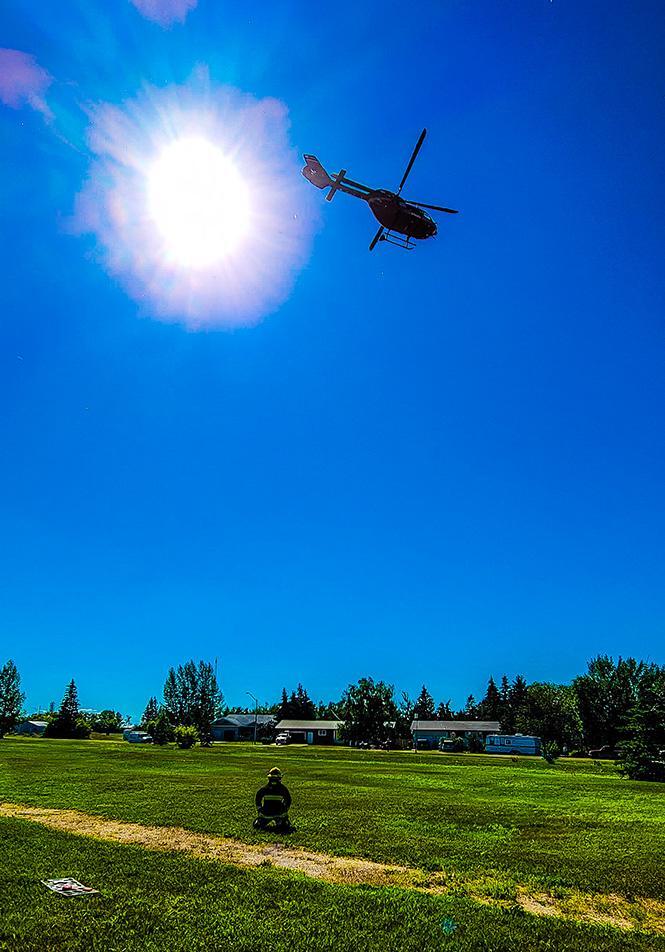
Co-host Lyle Aspinall: Back in Laird, the STARS helicopter was parked roughly 100 metres from the scene, across a gravel road and near a gazebo in a large public park. As pilots Alex Parra and Yves Bolduc started it up, Draidyn was strapped onto the stretcher and several helpers began carrying him to the open rear doors. First responder Kevin Burrell was among them. He had been in Saskatoon when the call originally came in and had seen the STARS helicopter leave the city when he began driving to Laird.00:12:53:24 – 00:13:32:15
Kevin Burrell: So I didn’t have any gear on. I was just in my normal street clothes. So, just by seeing what I saw, I could recognize that they were getting close to loading him up and taking him away. So I went to one of our firefighters that was in full PPE and wasn’t a first responder yet, I said, You go over, work the landing zone, I’ll take over here for you. So I took over what he was doing. We got him on to the spine board. They already had an IV going in him. We loaded him up onto the stretcher, strapped him on. We had to put his arms up, on an– that was kind of scary.00:13:32:18 – 00:13:42:18
Co-host Lyle Aspinall: However, Draidyn was finally on the stretcher and free of the lawnmower. And it was then that the first glimmers of hope began to emerge. Here’s flight paramedic Glen Pilon.00:13:42:21 – 00:14:08:18
Flight paramedic Glen Pilon: I think my outlook on Draidyn’s future changed when we moved him from the ground to the helicopter stretcher, and we had our cardiac monitor on there. We had a blood pressure on his leg. We had a pulse oximetry on his finger. We had cardiac monitoring on him. And when I saw all those numbers, and I love those numbers, that’s when my outlook changed for him.00:14:08:18 – 00:14:12:15
Co-host Deborah Tetley: Love your big smile there. The audience can’t see this, but you’re smiling.00:14:12:15 – 00:15:21:14
Flight paramedic Glen Pilon: That was the turning point for me because when he was underneath the lawnmower and– Imagine this, that you’re infusing blood into his right arm and you have an intravenous in his elbow. You need to put a blood pressure cuff on that right bicep. And that has to squeeze. And that’s going to stop the blood flow that we’re trying to infuse into him. So we have no blood pressure other than just palpating his carotid artery. And we know that by doing that, his blood pressure could be as low as 50 systolic. So we didn’t want to put a blood pressure cuff on his right arm and have the possibility of stopping the blood, and also losing that intravenous that’s in his right elbow. So we decided not to put the blood pressure cuff on him while he was underneath the lawnmower with the lawnmower on him. Once we had the lawnmower off, we could cut off his jeans, get him on a stretcher, and we can put the blood pressure cuff on his leg, which gave us a number. And that was our turning point for me.00:15:21:17 – 00:15:28:14
Co-host Deborah Tetley: It was a turning point for Bailey as well. For the first time since their care began, hope emerged for her too.00:15:28:16 – 00:15:44:06
Flight nurse Bailey Sinclair: In flight, on our way back, we were able to get some vital signs. We were able to alert the hospital that we were on our way, that they would need some blood ready and that they needed the trauma team there and ready for Draidyn to meet us there because this kid was very, very sick.00:15:44:08 – 00:15:46:22
STARS EMERGENCY LINK CENTRE — Flight nurse Bailey Sinclair: … STAR 11, Are you able to hook me up with our TP, please?00:15:46:25 – 00:15:50:15
STARS EMERGENCY LINK CENTRE — Shae: Yeah. One sec, Bailey.00:15:50:17 – 00:15:51:05
STARS EMERGENCY LINK CENTRE — Segun: Hello.00:15:51:08 – 00:15:54:19
STARS EMERGENCY LINK CENTRE — Shae: Hi, Dr. Oyedokun. Just have Bailey with STAR 11 looking to connect with you.00:15:54:22 – 00:15:55:04
STARS EMERGENCY LINK CENTRE — Segun: Okay,00:15:55:08 – 00:15:57:08
STARS EMERGENCY LINK CENTRE — Shae: Bailey, you have Dr. Oyedokun, go ahead.00:15:57:10 – 00:16:09:08
STARS EMERGENCY LINK CENTRE — Flight nurse Bailey Sinclair: Hey, Dr. Oyedokun, it’s Bailey. We have just got him loaded. We are going to be back in Saskatoon in hopefully about 15 minutes. We’re running our second unit of blood. We’ve pressure-infused one gram of TXA. Do you want another gram?00:16:09:12 – 00:16:13:17
STARS EMERGENCY LINK CENTRE — Segun: Yeah, just give a second one. Give a second one. That’s okay.00:16:13:19 – 00:16:20:14
STARS EMERGENCY LINK CENTRE — Flight nurse Bailey Sinclair: Okay. Sounds good. We are just going to load, so I’m probably going to lose you here. But we will be in Saskatoon shortly.00:16:20:17 – 00:16:21:10
STARS EMERGENCY LINK CENTRE — Segun: Okay.00:16:21:12 – 00:16:22:07
STARS EMERGENCY LINK CENTRE — Flight nurse Bailey Sinclair: Okay. Thanks, Dr. Oyedokun.00:16:22:13 – 00:16:24:00
STARS EMERGENCY LINK CENTRE — Segun: All right.00:16:24:02 – 00:16:25:16
STARS EMERGENCY LINK CENTRE: STAR 11, Link Centre go ahead.00:16:25:18 – 00:16:28:17
STARS Emergency Link Centre — Alex Parra: …1553 the scene, thanks…00:16:28:19 – 00:16:36:13
STARS EMERGENCY LINK CENTRE: And STAR 11, Link Centre. Transmission broke off. I did copy. You were up at 1553. Your landing zone has been requested secure at Jim Pattison.00:16:36:16 – 00:16:42:11
STARS Emergency Link Centre — Alex Parra: And just be aware, we’re gonna need at least two units of blood to get ready for us. We’re using our blood.00:16:42:14 – 00:16:54:02
STARS Emergency Link Centre — Alex Parra: STAR 11 copy. 1556. And copy remarks in regards to the blood.00:16:54:04 – 00:16:59:00
Co-host Lyle Aspinall: And now, a quick word from our Season 2 sponsor.00:16:59:03 – 00:17:34:29
ARC Resources ad spot: As Canada’s third largest natural gas producer and the largest producer of condensate, ARC Resources is proud to play an important role in the responsible development of Canada’s energy resources in delivering those resources. Safety is the number one priority, always, and it’s that core value that makes ARC’s partnership with STARS a natural fit. It’s our shared goal to ensure that everyone arrives home safely at the end of the day. Learn more about how ARC is leading the way for safe and responsible energy development at arcresources.com.00:17:35:01 – 00:17:49:21
Co-host Deborah Tetley: Welcome back. Draidyn wasn’t the only non-STARS passenger on board the helicopter for that flight. I asked Yves Bolduc, the pilot who flew this mission, about the extra ridealong.00:17:49:23 – 00:18:05:13
Co-host Deborah Tetley: So, we understand that something rare happened on this mission, and that is we took Draidyn’s mom in the helicopter. Can we talk about that a little bit? How rare it is, how we make those decisions? What protocols, what do you guys discuss when taking along a mom or dad?00:18:05:15 – 00:18:47:14
Yves Bolduc: The consideration was, at the time, because his injury was so severe at the time, they didn’t know if he was going to make it or not, right? Therefore, at least, you know, you have that mom with us there. But not only that, the mom, you know, has a background in health care as well. So we knew that we had someone that understood what our medical crew was doing. It was a mom that understood, you know, that you need to be calm for the sake of your kid and for the sake of our crew. They need to be focused on, you know, keeping him, you know, as stabilized as possible until they got to the emergency room. Okay. So that that was the reason why there was no question about it, you know, for that instance.00:18:47:16 – 00:18:52:11
Co-host Deborah Tetley: Alex Parra was the safety pilot on this mission. So it was his job to prepare Draidyn’s mom.00:18:52:14 – 00:19:00:20
Alex Parra: And I do remember just telling her just, you know, whatever happens in that helicopter, just let them do the job. He’s in a good hands. Don’t panic.00:19:00:22 – 00:19:03:29
Co-host Deborah Tetley: Flight nurse Bailey Sinclair said Christine was a model passenger.00:19:04:02 – 00:19:32:10
Flight nurse Bailey Sinclair: That was a bit of a different experience having her along, but it didn’t change what we did. I remember thinking, what must this feel like for her? She was so calm and collected and cooperative, and I could not believe how well she was handling it, when her 16-year-old son, when she had just seen him under a lawnmower like that. I remember just thinking. I can’t imagine how she’s feeling.00:19:32:12 – 00:19:40:00
Co-host Lyle Aspinall: Glen said although it’s rare for a parent to join a flight like this, he prefers to do it whenever possible. It’s always assessed on a case-by-case basis.00:19:40:02 – 00:21:18:10
Flight paramedic Glen Pilon: Yeah, absolutely. There’s one of the things that we can talk about on the way out to the call. If there’s a parent there, especially for somebody under the age of 16, that’s a pediatric patient and is going to be going to the pediatric intensive care unit, we want to bring a parent along with us. And so we told our safety pilot that we want to bring mom with us. And then mom gets the safety briefing, where she’s going to sit on the helicopter and how to put the seatbelt on and how to take the seatbelt off in case of an emergency and stuff like that. So the safety pilot is doing those things while the other pilot is in the helicopter with the helicopter running. And so, yeah, it’s a busy little environment. And, sometimes you wonder, you know, are you going to have two patients on that helicopter on that flight back to the hospital? Because not only do you have the critical injured pediatric patient, but you’ve also got a distraught mother that’s with you too that can take up a lot of your time when you need to focus your time to the pediatric patient. Those are things that you deal with on scene. You kind of assess what the mother is doing at the time when you’re trying to work on their child, and if you see that the parent is quite frantic and is in a lot of shock– Bailey and I would have that discussion on the way to the helicopter to say, maybe we shouldn’t bring mom along. Maybe mom should go in a family vehicle to the hospital because we’re not going to have time to deal with that. But she was incredible. She was so calm and collected. We knew that we weren’t going to have a problem or deal with the mother on the way to the hospital, as well as dealing with a critical, injured pediatric patient.00:21:18:12 – 00:21:30:01
Co-host Lyle Aspinall: Remember in a previous episode when Christine said she, quote, corrected her behaviour when she found herself acting on her emotions upon arriving at the scene? Well, she said she used that same discipline inside the helicopter.00:21:30:03 – 00:22:27:10
Christine Wollmann: They sat me into the helicopter and I saw them bringing Draidyn, and then they loaded Draidyn up and we took off. And I just would– first of all, I didn’t really look at Draidyn because I didn’t know exactly what I was dealing with. So I would just look out on our town as we were leaving. And then I looked at the monitor and I saw that his vitals were good. So I’m like, okay, he’s going to make it. And then I did see, like, a bandage over his chest and that’s all I– And then, I thought, no, I’m just going to look at the monitor. And then I looked outside. And that’s all I just kept doing is, I just kept looking back and forth. And then I did see the paramedic on STARS, he had an ultrasound on his phone, which I thought was really cool. And then, so I kind of saw that, but I didn’t see what he was looking at.00:22:27:12 – 00:22:44:14
Co-host Lyle Aspinall: That was Glen operating the ultrasound. In fact, he was doing that in one hand while at the same time essentially breathing for Draidyn by regularly squeezing a manual resuscitation bag in his other hand, something he would normally leave to a machine. But it was such a short flight it made sense for him to just do it himself.00:22:44:16 – 00:23:07:03
Flight paramedic Glen Pilon: While bagging with my right hand, I was using my left hand to assess for a pneumothorax. And so I was using the ultrasound and looking at the ultrasound to see if there was lung-sliding on the ultrasound to see if he had a collapsed lung from that blade being in his chest. And he did not have a pneumothorax.00:23:07:03 – 00:23:07:27
Co-host Deborah Tetley: It just gave me chills.00:23:07:28 – 00:23:08:28
Flight paramedic Glen Pilon: So yeah,00:23:09:00 – 00:23:26:11
Co-host Lyle Aspinall: I can’t imagine that. I mean, I’ve been in the helicopter while a mission is going on, and it’s loud and it’s moving and it’s shaking, and in one hand you are manually bagging, and in the other hand, you’ve got an ultrasound going on, and Bailey’s doing her thing. And at some point in the 17-minute flight, somebody’s got to talk to the hospital and tell them what’s incoming. What are you telling the hospital at that point?00:23:26:14 – 00:23:43:18
Flight paramedic Glen Pilon: Yeah, it’s only a 17-minute flight, so you want to give them as much notice as you can so that they can prepare and have all their teams ready to go when the patient arrives. And so there are a lot of things that need to be done in the helicopter in that 17-minute flight. And it can get quite busy in there.00:23:43:20 – 00:23:45:25
STARS EMERGENCY LINK CENTRE: STAR 11 Link Centre, go ahead.00:23:45:28 – 00:23:49:00
STARS EMERGENCY LINK CENTRE — Flight paramedic Glen Pilon: Can I get a patch to RUH, please?00:23:49:00 – 00:23:52:21
STARS EMERGENCY LINK CENTRE — Flight paramedic Glen Pilon: STAR 11, roger, standby for patch.00:23:52:24 – 00:23:53:28
STARS EMERGENCY LINK CENTRE — JIM PATTISON CHILDREN’S HOSPITAL: Peds emerg.00:23:54:01 – 00:23:57:29
STARS EMERGENCY LINK CENTRE: We’re inbound with a 16-year-old from a scene call up in Laird. You guys are aware of the patient coming in?00:23:58:00 – 00:23:58:24
STARS EMERGENCY LINK CENTRE — JIM PATTISON CHILDREN’S HOSPITAL: Yes. Yes.00:23:58:26 – 00:24:02:28
STARS EMERGENCY LINK CENTRE: Perfect. Our crew is looking for the inbound patch. I will link you in now. Okay?00:24:03:00 – 00:24:03:28
STARS EMERGENCY LINK CENTRE — JIM PATTISON CHILDREN’S HOSPITAL: Okay.00:24:04:01 – 00:24:07:12
STARS EMERGENCY LINK CENTRE: STAR 11 medical, it’s the Link Centre. You’re online with RUH peds emerg. Go ahead, please…00:24:07:12 – 00:24:19:24
STARS EMERGENCY LINK CENTRE — Flight paramedic Glen Pilon: … angulated, deformed left arm. And we have a heart rate of 176, a pressure of 74 on…00:24:19:27 – 00:24:53:04
Flight paramedic Glen Pilon: And there’s another unit of blood that needs to be infused in the helicopter on the way to the hospital. So Bailey is busy, and we also have to sedate the patient, too. If the blood is starting to profuse the patient, profuse the brain, and the patient starts to wake up, and then when the patient starts to wake up, they can reach up and they can grab the endotracheal tube and they’ll pull it out. So Bailey has to also sedate the patient and draw up medications to keep the patient sedated as well. So it’s a busy 17 minutes in that helicopter to the helipad.00:24:53:06 – 00:25:05:09
Flight nurse Bailey Sinclair: But I remember just feeling a bit of relief when he had some pretty good vital signs and felt like we were going to be okay to make it to the hospital. We were going to get him to his next step of his care.00:25:05:11 – 00:25:22:02
Flight paramedic Glen Pilon: Yeah, so we land on top of the helipad at the Jim Pattison Children’s Hospital, and we go down to the trauma room. And there is an amazing, a massive team waiting for him. And we hand over care and we give our report, and they do their thing.00:25:22:04 – 00:26:06:17
Flight nurse Bailey Sinclair: I used to work in the emergency department, both the adult and pediatric emergency. So taking Draidyn down the elevator and into the trauma room, I saw a lot of my colleagues. I saw the whole trauma team waiting for him. I saw the pediatric emergency team waiting for him. There were just so many people who were there to help Draidyn, and I remember just feeling such relief that all of these people and all of these capable, amazing health care providers were there to help Draidyn. And I think that was just a sense of relief for me, was, we got him there, we got him there safely, and we got him there alive. And now it was up to these people to take over and continue on with Draidyn’s care at that point.00:26:06:19 – 00:26:12:06
Co-host Deborah Tetley: And obviously, because you’d work with them, you knew that he was in the best of hands, right? Like, that must have felt very confident for you.00:26:12:07 – 00:26:13:26
Flight nurse Bailey Sinclair: Yeah, absolutely.00:26:13:28 – 00:26:24:13
Flight paramedic Glen Pilon: They start getting bloodwork drawn. They do CT scans. They take him to the operating room. And just incredible, like, an incredible team to hand over care to. It’s just,00:26:24:16 – 00:26:30:14
Co-host Lyle Aspinall: I know Christine was pretty amazed by what she saw on the receiving end in the hospital.00:26:30:17 – 00:26:44:18
Flight paramedic Glen Pilon: Yeah, absolutely. For a mother, you know, like, to be in a parent’s perspective, like, to finally be in the hospital, and you know that you’re kind of out of a little bit of the woods. It’s a great feeling to have.00:26:44:20 – 00:26:54:07
Co-host Deborah Tetley: Let’s hear it from Christine. Remember, she’s a trained first responder, and she was still in uniform from having rushed away from her day job at a nursing home when she first heard about Draidyn’s injury.00:26:54:10 – 00:28:46:07
Christine Wollmann: And I followed him and they brought him into this room and there was like probably 20 people with yellow gowns just surrounding him. It was so cool to see. It reminded me of bees going to a hive. It was just so cool. I’m standing there just watching and observing, and then the social worker comes up to me and asks me, are you mom? And I says, yes, I’m mom. She goes, I can’t believe how calm you are right now. And I said, well, panicking doesn’t help. And said most of it has to do with my training. And then she goes, yeah, but you’re blending in with my staff. Because I had my scrubs on from work. And then they went and took me into a room where I sat with her for a little while, and three doctors came in. And they told me that his arm was cut in a million pieces and that they could try and salvage it, but they said that it wouldn’t be functional and it would be dead. And they said there’s risk of infection. And I just said, you do whatever you got to do to save his life. And they left, and then the other doctor — this is what I was waiting for — he told me that Draidyn’s muscle was just shaven off of his chest and that his ribs were actually cracked upwards, and that’s all that had happened. And I’m like, okay. And right then and there, I knew that God was there. And then afterwards he went– They had surgery. And then we were in ICU.00:28:46:10 – 00:28:54:25
Co-host Deborah Tetley: Draidyn did have a massive wound to his chest, but surprisingly, the mower blade narrowly missed puncturing his lung or causing significant damage to any major organs.00:28:54:28 – 00:29:41:14
Christine Wollmann: His wound was like, it was 20 cm by 20 cm. And when I was reading the doctors reports, it said that there was grass, dirt, rocks and all that all around it, and they could see his right lung and his diaphragm and but there was, like, nothing inside. And I thought that was amazing. So at first they were really concentrating on his arm and his chest. And then after we found out that he had two fractures in his hips, and then he had a huge blood blister on the bottom of his heel from being dragged.00:29:41:17 – 00:29:55:01
Co-host Lyle Aspinall: But what about his arm? After all, his left arm was under the mower deck, and we heard earlier from Bailey that it was significantly damaged. Well, the moment Draidyn came out of his induced coma, he had one very specific question for his mom.00:29:55:04 – 00:30:38:17
Christine Wollmann: When he was in the induced coma, I’d get my family members to talk to him just so that he could hear their voices. And I was on the phone with my cousin Sheldon. Sheldon said, “Hi, buddy” to him, and he opened his eyes. And it freaked me out, and I’m like — gasp! And I go to the doctor, “He’s awake!” I said, “Sheldon, I got to call you back. He just woke up.” So they ended up taking the breathing tube out shortly after that. And when they did, the first thing that Draidyn asks is, is my arm gone? And they said, unfortunately, yes, but it saved your life.00:30:38:19 – 00:30:40:25
Co-host Lyle Aspinall: Next time on Mission Ready.00:30:40:28 – 00:30:45:29
Co-host Deborah Tetley: You said something earlier that you were talking to yourself in your head. What were you saying?00:30:46:01 – 00:30:55:08
Draidyn Wollmann: Well, I’m not going to — bleep — die. I’m not going to — bleep — die. I’m going to figure out how to get out of this.00:30:55:10 – 00:30:57:00
Co-host Lyle Aspinall: Draidyn. In his own words.00:30:57:02 – 00:31:02:06
Draidyn Wollmann: That’s why I was repeating to myself in my head.00:31:02:09 – 00:31:07:12
Co-host Deborah Tetley: Mission Ready, presented by ARC Resources, is produced in-house by me, Deborah Tetley.00:31:07:19 – 00:31:13:11
Co-host Lyle Aspinall: And me, Lyle Aspinall. Watch video clips from this season at stars.ca/missionready.00:31:13:13 – 00:31:30:02
Co-host Deborah Tetley: Mission Ready contains original theme music by Kaiya Gamble, whose dad was a long time STARS pilot and whose mom was once a transport physician. Check her out at kaiyagamble.com. Please rate and review Mission Ready wherever you found it, and be sure to tell your friends about it. Also, check out Season 1.00:31:30:04 – 00:31:36:16
Co-host Lyle Aspinall: Want to be a STARS ally? Get involved and support our mission by visiting stars.ca. Until next time, thanks for listening.