
STARS on Scene

![Apple Podcasts md:mr-[10%]](/apple.png)


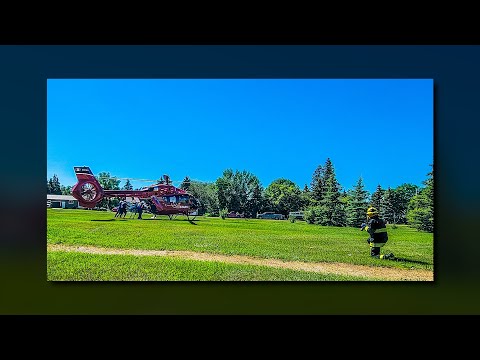
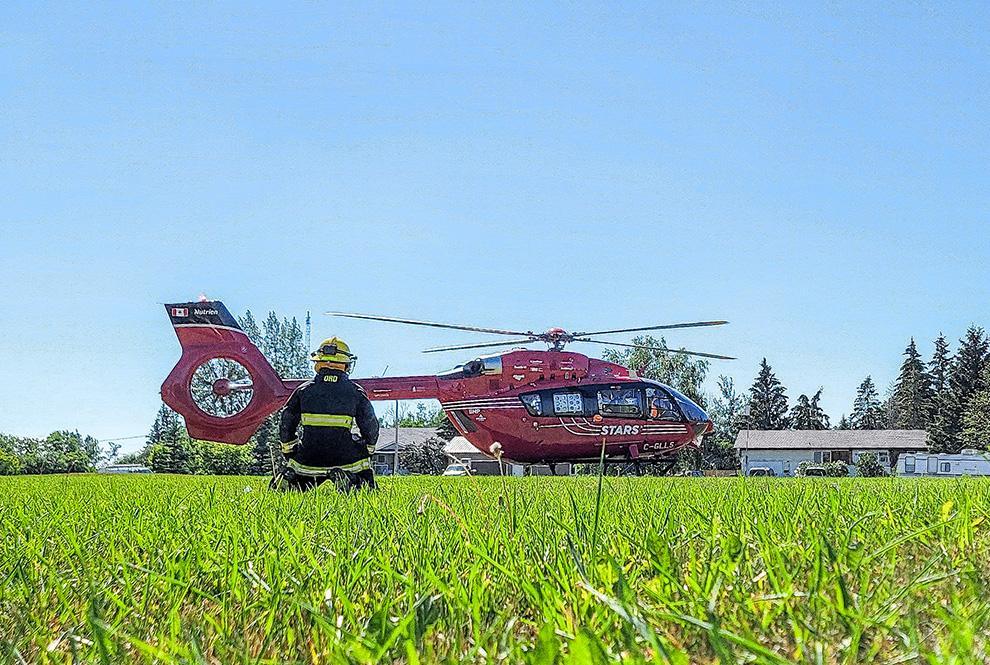
A STARS helicopter lands near the bustling scene where Draidyn Wollmann’s life is ebbing away from beneath the cutting deck of an industrial lawnmower. Skilled air medical crew members are stunned by what they see but lean on their robust training to quickly begin transfusing blood into Draidyn’s only intact arm and taking over his breathing. Both STARS pilots help in whatever way they can. Watch all four STARS crew members talk about their initial reactions in a bonus video below.
I had that initial shock moment of, “Wow, this is nothing I’ve ever experienced before. This is scary, this is bad.” But then I think that’s the time when your training kicks in and you know what you need to do.”
- Bailey Sinclair, STARS flight nurse
Episode 3 Bonus Content
-
Season 2, Episode 3 Transcript
00:00:01:28 – 00:00:33:19
Co-host Deborah Tetley: Before we start, a word of caution. As you know, STARS provides pre-hospital care for critically ill and injured patients who have sustained severe trauma or debilitating illnesses. It’s what we do. As such, some of the details in this podcast may be difficult for some listeners. The STARS mission being explored this season involves graphic descriptions of physical injuries to a youth. Psychological impacts are also detailed. The patients, family, and supporters have generously allowed us to tell this story as a personalized insight into STARS.00:00:33:21 – 00:01:07:05
Co-host Lyle Aspinall: And for that, we are genuinely grateful. The community, and everyone else who was involved, welcomed us with open arms to help us tell this story. Having spent time with about 20 people researching it and recording interviews on the phone, virtually, in studio, and right at the scene of the incident, we can tell you this: our conversations were raw and candid, and as such, some of the details uncomfortable. For this podcast, we’ve endeavoured to tell the story accurately without being too sensational. Still, listener discretion is advised.00:01:07:07 – 00:01:43:11
Alex: This scene was very traumatic because I had never seen anybody eaten by a lawnmower that way. You can see, like, the whole blades were on top of the kid, and the only visible part of his body was the head and one shoulder. I don’t remember if it was left or right, but… And based on the people he was around, they said that basically his body stopped the machine. So you can imagine the severity of the injuries that a body can, you know, get from those blades turning to make the whole thing stop.00:01:43:13 – 00:01:58:16
Co-host Deborah Tetley: Welcome to Mission Ready, presented by ARC Resources. This STARS podcast breaks down in detail one mission each season to give you a stronger understanding of how we provide critical care anywhere, and what happens before and after the mission. I’m Deborah Tetley.00:01:58:18 – 00:02:15:25
Co-host Lyle Aspinall: And I’m Lyle Aspinall. In Season 2, we’re analyzing an emergency response to a traumatic incident where a teenager was run over by an industrial-sized riding lawnmower in Laird, Saskatchewan. This is Episode 3: STARS on Scene.00:02:15:28 – 00:02:29:08
Co-host Lyle Aspinall: Last week, you met several of the very first people who responded to 16-year-old Draidyn Wollmann becoming trapped under the cutting deck of an industrial riding lawnmower. First responder Kevin Burrell was one of them and wasn’t sure Draidyn would make it.00:02:29:11 – 00:02:38:01
Co-host Lyle Aspinall: And so when you hear on a call that you’re attending that STARS is on its way, or it might be required, what goes through your mind?00:02:38:03 – 00:02:45:11
Kevin Burrell: First thing that goes through my mind is, oh, boy, this must be serious. They wouldn’t come out if it’s not.00:02:45:13 – 00:02:56:07
Co-host Lyle Aspinall: The STARS crew, responding from Saskatoon, 60 km away, included flight paramedic Glen Pilon, a 30-year veteran of his trade, and flight nurse Bailey Sinclair.00:02:56:09 – 00:03:00:02
Bailey: I think Draidyn’s call will always stand out for me.00:03:00:04 – 00:03:04:09
Co-host Lyle Aspinall: This was Bailey’s first solo shift with STARS after many weeks of intense training.00:03:04:16 – 00:03:34:11
Bailey: I’ve never been in an experience like that where somebody is still actively trapped under a lawnmower. Also, I think it’s always just different and hits a little harder when it’s a kid. It’s just more emotional, I think. Like, he’s such a young person. He’s got his whole life ahead of him. You just want what’s best for him. And I think you just always think and feel for that person and his family and what they’re going to be going through in the upcoming weeks, months, years.00:03:34:13 – 00:03:55:15
Co-host Lyle Aspinall: Bailey wasn’t the only new STARS team member to be involved in this call. Almost 700 km away in Calgary, Shae Evans was relatively new in her role as an emergency communications specialist on the critical patient side of the STARS Emergency Link Centre. She had already fielded hundreds of industry service calls for STARS vigilant on the other side of the room. But the logistically challenging world of critical patient coordination was a fresh start.00:03:55:17 – 00:04:29:04
Shae Evans: Yeah, so I (was doing) what we call is logistics. So, whoever is on logistics is in charge of the helicopters. So, we’re the ones on the radios pre-alerting, dispatching. We’re the ones that have charge of getting the landing zone done. So, whether that be fire, RCMP, or if it’s really rural and we can’t get fire and RCMP, maybe the EMS truck has to do a landing zone. So, you got to make sure that there’s somewhere for your your team to land safely. You’re giving all the information to the medical crew. You’re basically the only, like, you’re the person answering the radio. So, any questions that need to be passed on, you’re doing that. It’s all about safety for the crew.00:04:29:06 – 00:04:41:13
Co-host Lyle Aspinall: Several members from the STARS Emergency Link Centre were involved in this call, including Lindsay Coates, who was handling the initial intake. Shae still remembers reading Lindsay’s notes as the STARS medical team in Saskatoon was brought into the call.00:04:41:16 – 00:04:56:21
Shae Evans: What the note said was, he was wrapped up in the lawnmower with blades sticking — multiple blades — through his chest. So instantly you’re like, oh my, yeah. Like, that’s serious. And you know, you call the crew and they instantly, like, you barely get a few words out, they’re like, yeah, let’s go. And it was a beautiful summer day.00:04:56:21 – 00:05:13:22
Co-host Deborah Tetley: They, like, checked the weather and they, I think, accepted dispatch in, like, two minutes. It was crazy. And yeah, instantly– I don’t think Lindsay got more than a couple words in before they’re like, yeah, let’s go. I don’t need to hear anything more. Text us the rest of the details. And they were out in 10 minutes, up in the sky on their way.00:05:13:22 – 00:05:16:03
STARS EMERGENCY LINK CENTRE: STAR 11, Link Centre, go ahead.00:05:16:05 – 00:05:20:19
STARS EMERGENCY LINK CENTRE — Glen Pilon: Skids up, outbound to the scene call in Laird. Four souls on board.00:05:20:22 – 00:05:31:24
STARS EMERGENCY LINK CENTRE: STAR 11, roger, Link Centre, I copy. Up with four souls, outbound Laird area scene call. We have Laird fire on provincial fire for your landing zone.00:05:31:26 – 00:05:46:24
Co-host Lyle Aspinall: Glen and Bailey were already deep into preparation mode. You’ll recall they had received an early alert from their off-duty manager, Daniel Kobylak, who was also a STARS flight paramedic and a volunteer first responder in his community not far from Laird, where Draidyn was fighting for life.00:05:46:27 – 00:05:55:11
Bailey: Glen and I spoke about it. We obviously knew as soon as we got the information that we were going to go on this call, and we wanted to help this kid out.00:05:55:14 – 00:06:05:12
Co-host Deborah Tetley: On the way out the door, they grabbed medications and other items, including a cooler containing two units of type O‑Negative blood, and they secured it safely in place at the back of the helicopter.00:06:05:14 – 00:07:01:12
Bailey: So, on the way to the call we tend to do a lot of pre-planning. We talk about different differential diagnoses, different things that we might need to do for treatment, different things that might be going wrong with the person. We prepare some medications. We prepared some upper blood tubing in case we need to administer some blood. We prepared some pain medication. Just a few things. It was a very quick flight. We didn’t have a lot of time to prepare. Just as we were kind of arriving on scene, we still really didn’t have any other information. We were circling for a landing, and I remember somebody from the ground calling up to us. And like, that doesn’t generally happen that often except for landing zone information. And I remember somebody calling up to us trying to give us more information. I believe it was at that time they had told us that the lawnmower was still on Draidyn, and that things were not looking good.00:07:01:14 – 00:07:13:22
Co-host Deborah Tetley: Let’s take a minute to tell you how Glen and Bailey got here. Glen’s been a paramedic for about 30 years. He joined STARS just a couple years after the Saskatchewan government invited us to establish a base in Saskatoon.00:07:13:25 – 00:07:50:26
Glen Pilon: So I was with Saskatchewan Air Ambulance when STARS started up in Saskatchewan 10 years ago. And for the first couple of years, I watched to see how it unfolded in Saskatchewan. And their hangar was right beside our hangar, by the airplanes. And so I would go over and talk with all of my colleagues that I knew, because some of them would work with air ambulance, and some of them would work with STARS. And, they told me, why don’t you have a seat in the helicopter here, Glen? See how it feels. And I sat in the helicopter…00:07:50:26 – 00:07:51:28
Co-host Deborah Tetley: And how did it feel?00:07:52:00 – 00:07:57:21
Glen Pilon: Oh, I put my application in that that evening. Yeah. And here I am.00:07:57:23 – 00:08:09:09
Co-host Lyle Aspinall: And what about Bailey? Well, critical care nursing runs in her family, so it was a natural fit to spend the first six years of her career as a registered nurse in emergency medicine and in an ICU before applying for a job at STARS.00:08:09:11 – 00:08:19:24
Bailey: I thought it was a very neat combination of both the pre-hospital and in-hospital environment, and I just wanted to be able to help people where they needed, to help them both.00:08:19:27 – 00:08:22:25
Co-host Lyle Aspinall: Okay, so they both like their role, but are they good at it?00:08:22:27 – 00:08:45:19
Glen Pilon: Yeah, this is the one thing that I really love about STARS is you have six different bases, all across Western Canada, and you can plop anyone into any position, and they are trained exactly the same. So, it doesn’t matter the name on the on the chest. You can work with anyone because we are trained exactly the same at STARS.00:08:45:19 – 00:09:26:07
Bailey: We’re so lucky in our training as nurses and paramedics. We are cross-trained, so I am trained to do the same things that paramedics train to do. The paramedics can do the same things I can do. We tend to stick more to our strengths, but the fact that we have the same education and the same learning experience is so beneficial to us. And like Glen said, like, I work in all three of the provinces as a pool nurse; I can jump on a helicopter in Grand Prairie, I know where everything’s located. And I know that the person I’m working with, even if I’ve never worked with them before, I know we’re going to have a good call because we’ve been trained the exact same way, and STARS training is just one of the best experiences and probably some of the best training out there.00:09:26:10 – 00:09:39:05
Co-host Lyle Aspinall: Every new member of our clinical team must first pass the rigorous STARS Critical Care and Transport Medicine Academy, or STARS Academy for short. That intense education was fresh in Bailey’s mind when Draidyn’s call came in.00:09:39:07 – 00:10:08:10
Bailey: I had just finished my training about three weeks prior. So, to work for STARS, you have to do some pretty intensive training. It’s about a 20-week program involving a lot of in-person training as well as online training, lots of simulation and a lot of ride-along shifts. So, we are provided this very excellent training, and then all of a sudden you’re placed into the world on your own and you no longer have that person there to help you when you need it.00:10:08:12 – 00:10:17:22
Co-host Deborah Tetley: They were going to have to use all their training on this mission. As they approached with limited information, every crew member was assessing what they were about to face.00:10:17:24 – 00:10:50:15
Glen Pilon: I picture in my mind, you know, just a push-behind lawnmower with a blade underneath it and how a 16-year-old can get underneath one of those. But you fly out and you get more information coming in that it’s a commercial-grade or industrial-grade lawnmower. And he’s underneath that. And we also got word that the blade was still in his chest and that the first responders who were on scene were going to wait for us to get there until– before they removed the lawnmower off of him.00:10:50:17 – 00:11:00:05
Co-host Lyle Aspinall: STARS helicopter missions always involve two pilots: one to focus on flying, the other to focus on safety and communication logistics. Yves Bolduc was flying this mission.00:11:00:08 – 00:11:18:12
Yves Bolduc: What I remember is they landed us fairly close, you know, to the scene. We’re just in a field, you know. There was a road, you know, right behind the helicopter, and there was the following field that was pretty much beside the arena where the actual scene was.00:11:18:14 – 00:11:33:01
Co-host Lyle Aspinall: Beside him was safety pilot Alex Parra. After 10 years at STARS, this would be one of Alex’s last shifts before beginning a new flying career overseas. We caught up with him through Zoom a year later, and the details of the mission were still clear in his memory.00:11:33:03 – 00:12:17:05
Alex: This scene was very traumatic because I had never seen anybody eaten by a lawnmower that way. You can see, like, the whole blades were on top of the kid, and the only visible part of his body was the head and one shoulder. I don’t remember if it was left or right, but… And based on the people he was around, they said that basically his body stopped the machine. So you can imagine the severity of the injuries that a body can, you know, get from those blades turning to make the whole thing stop. And obviously, immediately you think, oh, this is crazy. This is, this is something serious.00:12:17:07 – 00:12:22:20
Co-host Lyle Aspinall: And now, a quick word from our Season 2 sponsor.00:12:22:23 – 00:12:58:01
Co-host Deborah Tetley: As Canada’s third largest natural gas producer and the largest producer of condensate, ARC Resources is proud to play an important role in the responsible development of Canada’s energy resources in delivering those resources. Safety is the number one priority, always, and it’s that core value that makes ARC’s partnership with STARS a natural fit. It’s our shared goal to ensure that everyone arrives home safely at the end of the day. Learn more about how ARC is leading the way for safe and responsible energy development at arcresources.com.00:12:58:04 – 00:13:06:11
Co-host Lyle Aspinall: Welcome back. Moments after the STARS helicopter landed in the nearby green space, flight nurse Bailey Sinclair took stock of what she saw.00:13:06:14 – 00:14:18:05
Bailey: So, at that point, we’re already there. We can see the scene. There’s all these people, all these first responders. I swear most of the community was out there helping Draidyn. Quite the amazing response from the small town first responder group. So, very good on them. I remember landing on the scene and, like, our training is absolutely incredible. It is the most in-depth, best learning experience I’ve ever, ever had. But being a nurse who works in a hospital, you’re not really exposed to that pre-hospital environment. So, I think I had only done a few scene calls in my learning experience, and to walk up in a call where the lawnmower was still on Draidyn, and all you could see was his head and his arm sticking out from under the lawnmower, that’s like an experience I cannot describe. It’s just, it was like nothing I’ve ever seen before. Like I said, they do the best to prepare you as much as they can, but nothing prepares you for that. I remember getting over to the patient. One of the EMS providers had walked over and kind of given us an update on what they had done, where they were at.00:14:18:07 – 00:14:20:14
Co-host Deborah Tetley: Glen remembers that conversation too.00:14:20:16 – 00:14:32:07
Glen Pilon: One of the paramedics from the ground ambulance came over, and we knew each other from previous calls and working together, and he said, Glen, this is very bad. This is really bad.00:14:32:10 – 00:14:38:24
Co-host Deborah Tetley: That ground paramedic was Gilbert Maraboto with Rosthern EMS, who you met in the previous episode.00:14:38:27 – 00:14:57:10
Gilbert Maraboto: When they landed, I met them at the landing site and I talk about, like, with Glen —I worked with Glen before, in the ambulance; he used to work with us in Rosthern too — and I remember sitting there, like, no, this is bad. This is very bad. I don’t know if he’s going to survive. As soon as we remove those blades, I’m pretty sure he won’t survive.00:14:57:12 – 00:15:23:19
Glen Pilon: Yeah, it was really tough. And, so, when we walked over to where he was, you could see this large, industrial-size lawnmower, and he was completely underneath the blades of the lawnmower lying on his back with only his head and his right arm sticking out from underneath the lawnmower. And he was trapped under there, basically.00:15:23:19 – 00:15:53:18
Bailey: They explained to us they were ready to lift this lawnmower off at any time, but they were waiting for us because they were worried that he might not make it once they lifted the lawnmower off of him. So, we got over to Draidyn. He was kind of in and out of consciousness, just gasping for air. He had an IV in the one arm that was out from the lawnmower. So immediately I started giving him blood.00:15:53:21 – 00:16:04:06
Co-host Lyle Aspinall: Let’s pause here for just a second. Remember that cooler of blood Deb mentioned earlier? The one Glen and Bailey grabbed before heading out on this mission? The story of how that cooler came to be is an interesting one.00:16:04:08 – 00:16:13:21
Glen Pilon: When I started here, we never carried any blood at all. And then because of a patient that required blood, initiatives were taken so that we would carry blood on board.00:16:13:23 – 00:16:44:10
Co-host Lyle Aspinall: Back in 2012, a woman named Carrie Derin was critically injured in an off-road vehicle mishap. At that point in STARS’ history, we weren’t carrying blood on board the helicopter, but Carrie desperately needed it. She was being cared for by a Regina STARS crew. They made a rapid pit stop at a small-town hospital to get a unit of blood started on her before continuing on to a trauma centre. That proved to be life-saving. Now, Carrie lived and became a strong STARS ally, and the mission spurred some deeper thought for Saskatchewan provincial director Darcy McKay.00:16:44:12 – 00:17:20:21
Darcy McKay: I was back at the base listening to this call and I thought, man, we’re taking time away from that patient, and we’re also taking that blood away from that hospital. And I thought, there’s got to be a better way. And so I just started looking at things, how can we have blood on board? And we looked at a variety of things. And then I came across these credo boxes that they actually used in the Iraq War, on the front lines. And I thought, maybe we can do something like that here. And so we had the lab transfusions from Regina General Hospital and Canadian Blood Services and the ministry on board. And, yeah, we made it happen. And it’s kind of cascaded across all of our bases. It’s awesome. It’s truly made a difference in patients’ lives.00:17:20:23 – 00:17:25:26
Co-host Lyle Aspinall: Well, and it’s not just every base at STARS that carries it now. We paved the road for others as well, didn’t we?00:17:25:26 – 00:17:39:18
Darcy McKay: Correct. It’s across North America, and actually, yeah– I’m going to say North America, yeah. So, lots of places are copying the model and that’s fantastic. It’s all about patient care.00:17:39:21 – 00:17:51:28
Co-host Deborah Tetley: Back in Laird, STARS has just landed and the medical response is underway on Draidyn. With time running short, Glen and Bailey dig deep into their extensive training and do everything they can to give him a fighting chance.00:17:52:00 – 00:18:21:29
Bailey: When we arrived on scene, I had that initial shock moment of, wow, this is nothing I’ve ever experienced before. This is scary, this is bad. But then I think that’s the time when your training kicks in and you know what you need to do. Like I said, that training is very intense, it is very thorough. And we practice and practice and practice, and that’s why we’re good at what we do. And that’s why we can turn it on when somebody needs it the most.00:18:22:01 – 00:19:38:22
Glen Pilon: Yeah, he is on ground level, he’s on his back, he’s looking up to the sky, and he has his right arm sticking out from underneath the lawnmower, right beside the wheel. And just from his neck up is all that we can see, really. And so we set up right at the head and we get all of our equipment out, we get all of our intubation equipment out, we get our bag valve mask, we get our oxygen out. And he had what we call, like, agonal breaths, like a very difficult breathing. And you try and palpate his radial pulse down by his wrist, and you can’t find one. And you try and palpate a brachial pulse by his elbow, and you can’t find one. And you can get your hand in to palpate the pulse around his neck, and he’s got a very weak pulse at his neck. And from my 30 years of experience, when somebody is trapped like that and very hypotensive and with difficulty breathing, you know that they only have about 10 minutes left to live. So, that was tough. That was really hard. Sorry. I kind of get a little emotional at these things,00:19:38:22 – 00:19:46:11
Co-host Deborah Tetley: No, don’t apologize. Yeah, I appreciate that’s probably just one of the hardest calls to go on.00:19:46:13 – 00:20:01:27
Glen Pilon: Yeah. Pediatric calls are some of the toughest calls to deal with because they have their whole life ahead of them, right?00:20:02:00 – 00:20:06:14
Co-host Lyle Aspinall: As Bailey and Glen set to work, pilots Yves and Alex helped them wherever they could.00:20:06:21 – 00:20:17:12
Yves Bolduc: The moment we land at any scenes, we become support, you know, to our guys who are trying, you know, to save a life. And we’ll do everything else that we can, you know, just to support them properly.00:20:17:18 – 00:20:32:18
Co-host Deborah Tetley: I’m always fascinated by that. You know, you’re not just flying the helicopter and then standing there doing nothing, right? Like you really are a part of this life-saving mission in more ways than getting the helicopter there. Can you talk a little bit more about that? What sort of things were you doing exactly that day?00:20:32:20 – 00:21:27:28
Yves Bolduc: I’m just going to be right in there, you know, to try to help them out and whatnot. But at the same time, it’s not push people around. Not at all. By the time you get to a scene, if EMS is already there, if fire is already there, they already have people that have been assigned specific duties at the scene themselves, right? So we become, you know, again, that support from behind, because we have some specific, you know, equipment, you know, that only STARS, you know, carries. And because of that, that’s– the type of running around that we’re doing around that day is, can you get us this bag because EMS did not have it, nor any of the firefighters had that type of equipment. And because we’re just a bit parked a little bit further away for security reasons, obviously, you know, we, you know, we’re there just to run back and forth. So I remember Alex, seeing Alex running back and forth, or I was running back and forth.00:21:28:00 – 00:21:31:17
Co-host Lyle Aspinall: Alex was spurred on by the look he saw in Glen and Bailey’s faces.00:21:31:23 – 00:21:58:03
Alex Parra: I don’t remember exactly what was the situation of the kid at that point, but I immediately, in my mind, and by the signs that the crew kind of make with the eyes, we were– okay, this is serious. So I start running to the helicopter and I went ahead of the game and I started bringing them stuff. I brought the blood, I remember I ran to the helicopter probably four or five times to bring equipment as the crew was instructing me to bring stuff, you know.00:21:58:06 – 00:22:15:21
Co-host Lyle Aspinall: Helping out at traumatic scenes comes naturally for many of our pilots. A large portion of them have military experience, which can often prepare them for the types of dynamic and potentially distressing situations inherent in STARS missions. For Alex, before his decade at STARS, he had actually flown helicopters for the Colombian Air Force.00:22:15:23 – 00:22:51:29
Alex Parra: Obviously, everybody knows, Colombia, we have gone through a conflict, internal conflict that actually has developed a lot of violence in the country. And all the institutions, government institutions, are trying to control this situation. And Air Force is one of them. As you be part of the Air Force, we were doing missions of medevac all the time. We were doing, you know, military missions. And you get exposed to seeing things that you’re normally not supposed to see.00:22:52:01 – 00:22:58:01
Co-host Lyle Aspinall: So, when he joined STARS, it came naturally to support his medical colleagues however he could. This mission was no exception.00:22:58:04 – 00:23:54:03
Alex Parra: I remember on the ground opening, I think, Bailey’s — It was one of the first missions that Bailey did after she finished her training. And for her, I could see on her face that she was really, you know, into the mission. And, because that’s what she was trained for. And Glen as well. Glen is a great paramedic with a lot of experience at STARS. And I remember myself opening bags, instructed by Bailey or by Glen when they said, Alex, give me this, give me that, like, I mean, all the bags that we have. And I just, you know, not even thinking, opening, setting up things. I remember opening the blood. I was the one that opened it, the blood cooler, cut the seals, take the unit out and, you know. And that helps a lot because a lot of the times they need that extra set of hands.00:23:54:05 – 00:24:04:15
Co-host Deborah Tetley: One very important step had already been taken by a ground ambulance crew. This was starting a large bore IV line in Draidyn’s arm. Bailey explains this.00:24:04:17 – 00:24:45:20
Bailey: So when we got to the scene, Draidyn had a large IV in his anticubital, or the kind of crease of his elbow there. The large IV lines are very helpful for us when we need to administer products really quickly. So, if you think of a garden hose, the bigger the garden hose, the more water flow you get through it. The smaller the garden hose, the less flow you get through it. So that works similar as an intravenous line. The bigger the IV, the faster we can give that blood product. So, the first responders on scene really helped us out by getting that large IV. And I think we were able to get the first unit of blood in before the lawnmower was even lifted off of Draidyn.00:24:45:22 – 00:24:51:24
Co-host Deborah Tetley: Kayla Burrell was among several first responders helping at the scene. She had an important job.00:24:51:27 – 00:25:31:25
Kayla Burrell: You know, at the end, I was holding the blood bag so that the blood could start flowing to Draidyn. And one of my fellow firefighters asked, Do you, like, want me to take over? Can I hold it? That was when I was like, No, I’m good. Like, this is– I wanted to do more. Like, this is all I can do right now is hold this blood. And, you just, you want to, you want to do more, you want to fix him right there. And, so, if that’s all I could do was hold that blood, that was important to me. And knowing that was critical, that his life was… he was fading.00:25:31:27 – 00:25:35:03
Co-host Lyle Aspinall: Next time on Mission Ready:00:25:35:05 – 00:25:55:12
Glen Pilon: And so we go ahead and make our intubation attempt. When I go to put the blade in, the top of the laryngoscope handle where the cord is, it hits the lawnmower and it is stuck there, and I’m not able to lift up in order to see the epiglottis that I need to see.00:25:55:15 – 00:26:03:19
Bailey: And I was kind of thinking, what is going to happen once we lift this lawnmower off of him?00:26:03:21 – 00:26:08:25
Co-host Deborah Tetley: Mission Ready, presented by ARC Resources, is produced in-house by me, Deborah Tetley.00:26:08:27 – 00:26:14:20
Co-host Lyle Aspinall: And me, Lyle Aspinall. Watch video clips from this season at stars.ca/missionready.00:26:14:23 – 00:26:31:12
Co-host Deborah Tetley: Mission Ready contains original theme music by Kaiya Gamble, whose dad was a long time STARS pilot and whose mom was once a transport physician. Check her out at kaiyagamble.com. Please rate and review Mission Ready wherever you found it, and be sure to tell your friends about it. Also, check out Season 1.00:26:31:14 – 00:26:37:26
Co-host Lyle Aspinall: Want to be a STARS ally? Get involved and support our mission by visiting stars.ca. Until next time, thanks for listening.