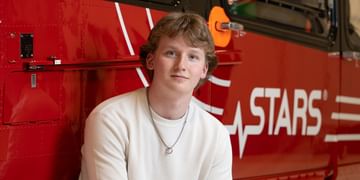
Thomas Wright

Zipping his new dirt bike through the remote Nisbet Provincial Forest, teenager Thomas Wright rounded a blind corner and crashed headfirst into another rider. Handlebars cranked and slammed into both kids, sending them sprawling.
Unlike the other rider, Thomas couldn’t get up. The pain was excruciating when he tried to straighten his right leg. A friend applied pressure to a bleeding wound while another dialed 911.
STARS flight paramedic Cary Serviss was on shift at the Saskatoon STARS base when the call came in. As a dirt bike rider himself, he knew the forest’s geography well.
“It can be quite a challenging area to get in and out of,” he said. “We knew the likelihood of landing close enough just to walk over was probably rare.”
As the helicopter flew over the forest, its crew searching for the crash site, Thomas’s parents, Bryce and Amy, drove toward the area.
“We could see STARS hovering above the area,” Bryce said. “It was like, ‘This is pretty serious.’”
His mom felt reassured. “It was almost a sense of calm,” Amy said. “It was like, ‘They’re here. They’ll get to him. They’ll find him.’”
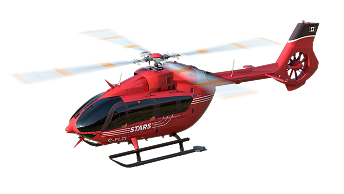
The crew soon spotted a person flagging them down, and pilots Aureo Agulha and Brad Steels eased the helicopter into a clearing roughly a football field’s distance away from Thomas.
From there, firefighters ferried Serviss and Chapman by off-road vehicle to Thomas’s side just as ground paramedics were finishing their primary assessment. Soon, Bryce and Amy arrived and watched the multi-agency coordination unfold.
“The effort to coordinate all of that — to keep him comfortable and get him to the helicopter — was impressive to see,” said Amy.
“We were suspecting a really bad pelvis fracture,” said Chapman. “With pelvic injuries, when bones start getting crushed, blood vessels can get cut. It can turn into a life-threatening bleeding situation internally. It was really important to get him out in a non-bumpy environment and quickly to the trauma centre.”
To secure Thomas for flight, the crew removed an arching mount from the STARS stretcher and propped his leg on coolers carrying blood.
If needed, Chapman and Serviss were ready to transfuse that blood, and they used onboard ultrasound to monitor for internal bleeding during the 20-minute flight.
“It’s pretty awesome to be able to bring the ultrasounds, the blood products, the analgesics, and the airway management skills to wherever a patient’s injured, give it at a high level and then get them quickly to a surgical centre,” said Chapman.
At the hospital, X‑rays confirmed what the crew expected.
“It was more serious than I ever thought,” said Thomas. “I completely broke the wing off my pelvis. Now I have nine small screws, one big six-inch screw, and three plates.”
The crash happened in April, and doctors told Thomas it would take three months to walk again. With hard work, he was back on his feet in six weeks — determined to join his graduating class on a Banff hiking trip in June.
“We went to Banff, and it was awesome,” he smiled. “It was definitely my highlight of high school.”
He’s grateful for the second chance that got him there.
“STARS was there when I needed them, and they came quick,” he said.
Amy agreed.
“You keep families together,” she said. “It’s that simple. That’s what STARS does.”
Donate to help patients like Thomas.
Donate Today